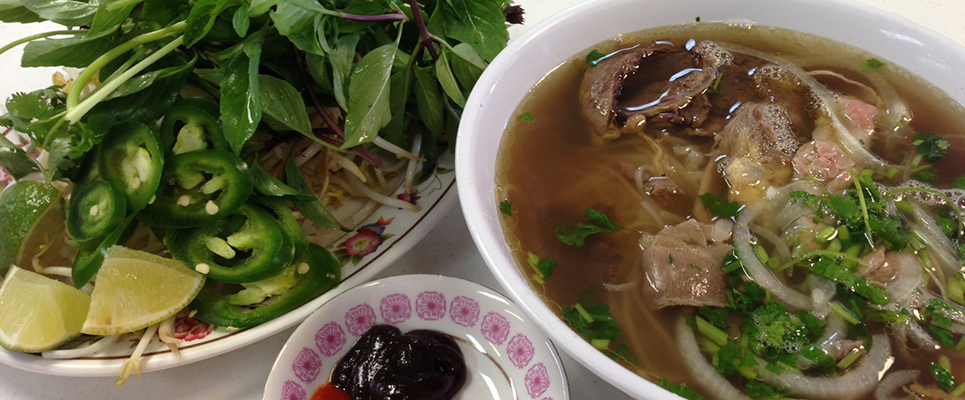
The amber colour behind Pho Hong’s broth
Pho Hong’s broth is the quiet centre of a beef pho bowl: aromatic, savoury and light enough to let the noodles, herbs and thin slices of beef speak. Its warm amber tone suggests depth, but it does not indicate a heavy, sweet or artificially coloured stock.
The answer to what gives our broth its amber color without caramel sauce is slow extraction. Beef, bones and carefully prepared aromatics build flavour and a natural golden hue over time. Nothing sticky or bittersweet is folded into the pot, and the result is meant to be drunk as broth rather than mistaken for gravy.
That distinction matters because caramel sauce changes both flavour and texture. It can darken a dish, add molasses-like sweetness and lend a glossy thickness. Pho Hong’s broth takes its character from the stock-making process instead, giving the bowl clarity while retaining the rounded savoury notes of a long-simmered broth.
Slow extraction creates the colour
A beef stock begins with collagen-rich bones, meat and water. As the pot simmers, gelatin, minerals and fine particles of fat move into the liquid. The broth becomes richer and more golden as extraction continues, while its aroma develops from mild beef notes toward a deeper roasted savouriness. Colour and flavour therefore arrive together rather than being added later.
Clarity is protected through gentle heat, regular skimming, controlled simmering and careful straining. A hard boil can scatter fat through the liquid and make it cloudy, while excessive heat may scorch the surface without improving the stock. That discipline is especially valuable in a seven-day restaurant, where preparation must fit around changing service demand. Broader regional food-service practices are available through South Pacific resources.
Onion, ginger and aromatic spices
Onion and ginger form the aromatic bridge between the beef stock and the spices. Lightly browning them develops colour and fragrance before they are used; deeper scorching would contribute bitterness rather than pleasant depth. This is caramelisation of plant aromatics, not the addition of caramel sauce, and the small pieces are strained away so the broth remains clean and fluid.
The familiar pho aromatics—cinnamon, star anise, cloves, coriander seed and fennel—bring perfume more than pigment. They are allowed to infuse the stock without being ground into it, which preserves the liquid’s clarity. The result should smell layered and warmly spiced while still reading as beef broth, with a light golden finish rather than a dark, syrupy one.
Why caramel sauce is unnecessary
Caramel sauce would push the broth beyond its intended savoury balance. Its sugar would taste noticeably sweet against lime, chilli and herbs, and its viscosity would coat the noodles instead of sliding around them. Even a small quantity changes the character of pho, so the cleaner approach is to build depth from meat, gelatin and aromatics alone.
The broth still has substance. Gelatin from the bones gives it a gentle body, while rendered fat and roasted aromatics carry rounded flavour. Hoisin, chilli sauce and herbs are offered separately so each diner can adjust the finished bowl. A darker seasoning added after the broth is poured cannot be confused with caramel hidden in the stock itself.
Serving broth in an Australian kitchen
For diners in Melbourne’s Richmond or Sydney’s Cabramatta, where Vietnamese bakeries, noodle shops and familiar herb combinations are part of the neighbourhood landscape, a clear beef pho can feel both comforting and precise. The restrained broth lets diners notice texture: springy noodles, fresh basil, coriander, bean sprouts and slices of beef.
That precision suits Australian takeaway habits, where lime, chilli, herbs and extra sprouts are often adjusted at the last moment. Soups are also packed for long working lunches, so the broth needs to remain distinct rather than thicken into a sauce. Sharing a large bowl at a weekend family meal is common, and a clean broth lets several condiments sit comfortably in the centre.
On hot days, Pho Hong’s iced drinks and smoothies offer a cooler counterpoint, while a warming bowl remains a familiar choice for cooler evenings. Austin diners can enjoy the same restaurant at 2521 Rutland Drive for dine-in service or order it during the designated delivery hours. The colour travels with the broth; the flavour does not depend on adding something sweet.
Matching broth with noodles and plates
Pho Hong’s beef pho shows the broth at its most direct, with thin beef, noodles and fresh garnishes in a fragrant liquid. Vermicelli bowls extend the idea with a lighter noodle and a different balance of toppings, while rice plates offer the savoury components beside grains and vegetables. Each format changes how much broth is present, but not the principle behind its colour.
The kitchen’s broader range of textures can be explored through the Pho Hong stir-fried noodles menu, where wok heat replaces slow simmering. Appetizers can begin a meal, while noodles and rice plates carry its middle and end. Even when the preparation changes, stock-led savouriness provides a useful point of comparison.
Reading the colour before ordering
A pale gold, translucent broth usually suggests well-extracted stock, while natural aromatics can carry it toward a warmer amber. A syrupy, dark-brown liquid with pronounced sweetness would point towards caramel or heavy reduction, neither of which is expected in Pho Hong’s broth. Cloudiness alone is not evidence of caramel; it can also reflect rough handling or emulsified fat.
At Pho Hong, the broth should remain savoury and translucent, with colour coming from the pot rather than from a dark sweetener. Understanding the source of that colour helps distinguish a naturally amber stock from a sauce-heavy or artificially coloured bowl.
The main sources can be compared directly:
| Source | Typical appearance | Main flavour effect | Role in Pho Hong’s bowl |
|---|---|---|---|
| Beef stock and browned aromatics | Clear to warm amber | Savoury depth and gentle body | Forms the broth |
| Caramel sauce | Deep brown, glossy and syrupy | Sweet and bittersweet | Not added |
| Soy sauce | Reddish-brown | Salty fermented umami | Separate condiment |
| Chilli oil | Red-orange sheen | Heat and toasted aroma | Separate condiment |